Kitchen Items Names in English: 40 Words With Pronunciation
Utensils, appliances, tableware and cooking verbs, with IPA, plain meanings, and a method for learning them from your own kitchen instead of a list.
PipWords: AI Word Camera

🌟 Why the kitchen is the best place to start
The 40 most useful English kitchen words are the utensils you hold daily (spoon, fork, knife), the appliances you switch on (fridge, oven, kettle), the tableware you eat from (plate, bowl, cup) and the verbs you do with them (pour, stir, boil, fry). All 40 are listed below with IPA pronunciation and short meanings.
The kitchen is the highest-return room in any home for a learner. Every object is used daily, most are within reach, and the vocabulary is genuinely frequent: unlike the animals and colours that beginner courses over-teach. A learner who owns these 40 words can describe an entire everyday activity, which is worth more than 200 words scattered across unrelated topics. If you are working towards the 2,000-word milestone from our vocabulary-by-age guide, this room is the fastest first 40.
🥄 Kitchen utensils and tools (12 words)
| Word | IPA | What it is |
|---|---|---|
| spoon | /spuːn/ | You eat soup with it |
| fork | /fɔːrk/ | Has points for picking up food |
| knife | /naɪf/ | For cutting: the k is silent |
| pot | /pɑːt/ | Deep, for boiling and soup |
| pan | /pæn/ | Flat, for frying |
| lid | /lɪd/ | The cover on a pot or jar |
| cutting board | /ˈkʌtɪŋ bɔːrd/ | You cut on it (British: chopping board) |
| peeler | /ˈpiːlər/ | Removes skin from vegetables |
| grater | /ˈɡreɪtər/ | Shreds cheese into small pieces |
| whisk | /wɪsk/ | Beats eggs quickly |
| tray | /treɪ/ | Flat, for carrying things |
| apron | /ˈeɪprən/ | Protects your clothes while cooking |
Pronunciation traps in this group: knife begins with a silent k (/naɪf/, not /knaɪf/), and the plural is irregular: knives. Apron surprises most learners: it is /ˈeɪprən/, rhyming with “grey”, not “app”.
🔌 Appliances and fixtures (10 words)
| Word | IPA | What it is |
|---|---|---|
| fridge | /frɪdʒ/ | Keeps food cold (short for refrigerator) |
| refrigerator | /rɪˈfrɪdʒəreɪtər/ | The full, formal word |
| freezer | /ˈfriːzər/ | Colder, makes ice |
| oven | /ˈʌvn/ | You bake inside it |
| stove | /stoʊv/ | The top where pans heat (British: hob) |
| microwave | /ˈmaɪkrəweɪv/ | Heats food in seconds |
| kettle | /ˈketl/ | Boils water for tea |
| toaster | /ˈtoʊstər/ | Browns bread |
| blender | /ˈblendər/ | Mixes fruit into liquid |
| sink | /sɪŋk/ | Where you wash dishes |
Oven is /ˈʌvn/: the o sounds like the u in “cup”, which almost every learner gets wrong on the first try. Note also that a water tap is tap /tæp/ in British English and usually faucet /ˈfɔːsɪt/ in American English; both are understood everywhere.
🍽️ Tableware and containers (8 words)
| Word | IPA | What it is |
|---|---|---|
| plate | /pleɪt/ | Flat, for a meal |
| bowl | /boʊl/ | Deep, for soup or cereal |
| cup | /kʌp/ | Small, for tea or coffee |
| mug | /mʌɡ/ | Bigger cup with a handle |
| glass | /ɡlæs/ | For cold drinks |
| bottle | /ˈbɑːtl/ | Tall container with a narrow neck |
| jar | /dʒɑːr/ | Wide glass container with a lid |
| napkin | /ˈnæpkɪn/ | Cloth or paper for your hands |
The cup / mug / glass distinction confuses learners in every language: a mug is a large cup with a handle for hot drinks, a glass is for cold ones. Jar starts with the same sound as “jam”: /dʒ/, not /j/.
👩🍳 Cooking verbs (10 words): the group most lists forget
| Verb | IPA | Example |
|---|---|---|
| cut | /kʌt/ | Cut the bread. |
| slice | /slaɪs/ | Slice the apple thinly. |
| peel | /piːl/ | Peel the banana. |
| pour | /pɔːr/ | Pour the milk into the glass. |
| stir | /stɜːr/ | Stir the soup slowly. |
| mix | /mɪks/ | Mix the eggs and flour. |
| boil | /bɔɪl/ | Boil the water for tea. |
| fry | /fraɪ/ | Fry the egg in the pan. |
| bake | /beɪk/ | Bake the cake in the oven. |
| taste | /teɪst/ | Taste it before you add salt. |
Verbs are what turn a pile of nouns into speech, and they are the group that picture dictionaries skip because a verb is hard to photograph. Learn each verb attached to its object: “pour the milk”, “boil the water”, because pairs are remembered better than single words, and the pair is what you will actually say.
⚡ How to actually learn these 40 words (not just read them)
Reading this table teaches almost nothing by itself: a word met once on a screen is usually gone within days. Four steps that do work, and take about three minutes a day:
- Stand in your kitchen and find five. Only five, and only ones you can touch. Say each word aloud while holding the object.
- Attach a verb to each. Not “spoon” but “stir with the spoon”. The sentence is what survives.
- Ask again tomorrow. Point at the object and ask “what is this called?”: recall, not recognition. See why kids forget words for the timing.
- Use one at dinner. “Pass the napkin.” One real use beats several reviews.
Eight days of five words covers this entire list, with reviews included. That is the whole method, and it is the same one in our 7-day word hunt plan.
📱 Hear every word in your own kitchen
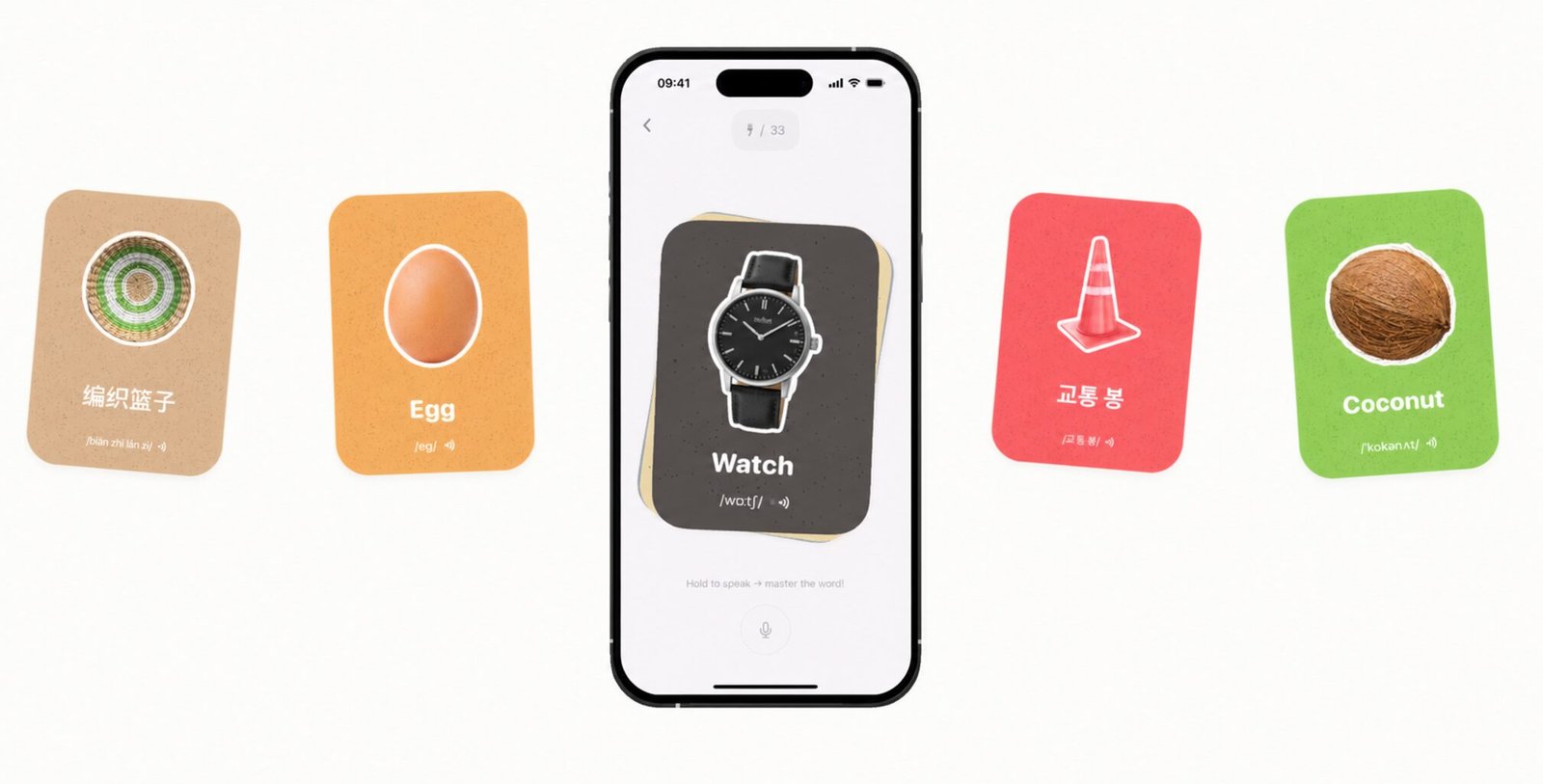
Written IPA only goes so far: most learners need to hear a word before they can say it. Point PipWords at your own kettle and in about 2 seconds you get a card with a cutout photo of your kettle, the word, the IPA, tappable audio and the translation in your language (17 available). Because the picture is your object rather than a stock photo, the word has something to stick to.
After that, the app handles the part nobody enjoys: bringing each word back on the right day, inside mini-games and boss battles rather than tests. Free on iPhone and Android, no ads, and only the cutout is ever shared, never the photo of your kitchen.
Conclusion
Forty words, one room, eight days. Kitchen vocabulary pays back faster than almost any other topic because you use it every single day, and because the objects are right there, you never need a flashcard to practise. Start with the five nearest things and add a verb to each.
❓ FAQ: English kitchen vocabulary
Q: What are the most important English kitchen words?
A: Spoon, fork, knife, plate, bowl, cup, pot, pan, fridge, oven, kettle and sink cover most daily situations. Add the verbs pour, stir, boil, fry and cut and you can describe a whole meal.
Q: What is the difference between a cup, a mug and a glass?
A: A cup is small and usually for hot drinks, a mug is a larger cup with a handle, and a glass is for cold drinks and made of glass.
Q: Is it a tap or a faucet?
A: Both are correct. Tap is standard in British English, faucet is common in American English, and each is understood in the other variety.
Q: How do you pronounce “oven” and “knife”?
A: Oven is /ˈʌvn/: the o sounds like the u in cup. Knife is /naɪf/ with a silent k, and the plural is knives.
Q: Fridge or refrigerator?
A: Both mean the same thing. Fridge is the everyday spoken word; refrigerator is the formal one you will see in writing and manuals.
Q: How many kitchen words should a beginner learn first?
A: Start with ten objects you touch daily, then add the ten cooking verbs. Ten well-known words beat forty half-known ones.
Q: Are these words suitable for children?
A: Yes. Kitchen vocabulary is ideal for children because every word has a touchable object. Let the child pick which five to learn first.
Q: How can I hear these words pronounced?
A: Any dictionary app plays audio, or point the PipWords camera at the real object to get the word, IPA and audio together in about 2 seconds.
🧑💻 About the Author
PipWords: the AI word camera
Written by the maker of PipWords, an independent studio run by a parent-developer. Word choices here follow the categories used inside the app, and IPA transcriptions are General American with British variants noted where they differ. PipWords runs on iPhone and Android in 12 interface languages with translations in 17, with no ads and no data selling.
A word we should add to this list? support@pipwords.site