Teach English Vocabulary at Home Without Flashcards: The 7-Day Word Hunt Plan
One room a day. Five words. Three minutes. A free plan any parent can follow: no teaching experience, no printing, no arguments.
PipWords: AI Word Camera
🌟 How to teach English vocabulary at home
The fastest way to teach a child English vocabulary at home is to hunt for words instead of studying them: pick one room a day, find five objects, say each word out loud, and revisit yesterday’s five before you start. Fifteen minutes a week, spread over seven short sessions, teaches around 35 words that the child chose personally, and those are the ones that stay.
This plan works whether English is your second language or you speak none at all. You are not the teacher in it: you are the person who says “let’s go hunting” and holds the phone. Everything below is free to do with any camera; the last section explains how an app automates the boring half (pronunciation, translation, tomorrow’s review).
❌ Why flashcards fail at home
Most parents start with flashcards or a word list app, and most stop within two weeks. Three reasons, and none of them is laziness:
- The words belong to someone else. A deck of 50 nouns chosen by a publisher has no connection to your child’s life. Nothing in it is theirs, so nothing in it is interesting.
- It looks like homework. A child who has just finished school recognises a test when they see one. Sitting still and being asked “what is this?” is school, at home, with a parent instead of a teacher.
- There is no tomorrow in it. Words met once fade within days. Flashcard sessions usually have no schedule for the second and third meeting, which is where the actual learning happens.
A word hunt fixes all three at once: the child picks the objects, the activity involves walking around the house, and each hunt starts by revisiting yesterday’s finds. The learning becomes a habit that looks like a game.
🗺️ The 7-day word hunt plan
One room per day, five objects per room, three minutes per session. Let the child choose which five: the odd choices are the memorable ones.
| Day | Hunting ground | Five words to find | Mini-challenge |
|---|---|---|---|
| 1 | Kitchen | spoon · cup · bowl · fridge · kettle | Find something round |
| 2 | Bedroom & toys | pillow · blanket · lamp · teddy bear · dinosaur | Find your favourite thing |
| 3 | Clothes | shirt · socks · shoes · jacket · hat | Find something with buttons |
| 4 | Bathroom routine | toothbrush · towel · soap · mirror · comb | Say the word while you use it |
| 5 | Outside | tree · leaf · flower · car · bicycle | Find something taller than you |
| 6 | Food shopping | apple · bread · milk · egg · banana | Find something you have never tasted |
| 7 | Review day | No new words | Child tests the grown-up on all 30 |
Day 7 matters more than it looks. Letting the child be the examiner, asking you the words and correcting your pronunciation, converts passive recognition into confident recall, and it is the session children ask to repeat.
🧠 The three rules that make words stick
Rule 1: say it out loud, twice. Silent reading builds recognition; speaking builds recall. Have the child say the word while touching the object, then once more while looking away from it. If you are unsure of the pronunciation, play the audio and copy it together: being a fellow learner is more useful here than being an authority.
Rule 2: meet every word again tomorrow, then next week. This is spaced repetition, and it is the single highest-return habit in vocabulary learning. Start each hunt with a 30-second look back at yesterday. Words that survive a second and third meeting rarely disappear.
Rule 3: let the child choose, and stop while they still want more. Five words is a target, not a quota; four chosen freely beat ten assigned. End the session before boredom arrives, so the next one starts with appetite. Three minutes done daily outperforms twenty minutes done twice.
What to avoid: correcting every mistake, translating instantly before they try to remember, and turning the hunt into a quiz with a score. The goal for week one is only that the child asks to do it again.
🎯 What to do after day 7
Week two is where good intentions usually die, because the parent now has 30 words to track by hand and no idea which ones are fading. Three ways to keep momentum:
- Change the hunting ground, not the routine. Grandparents’ house, the supermarket, the park, the car. Same three minutes, new territory.
- Give the words a job. A word used at dinner (“pass the spoon”) is worth three reviews. Ask for objects by their English name for the rest of the week.
- Hand the tracking to an app. Photographing, pronouncing, translating and scheduling reviews is exactly the part that software does better than a tired parent at 8pm.
📱 Run the plan automatically with PipWords
PipWords is the word hunt as an app. The child points the camera at an object and in about 2 seconds it becomes a card with a cutout sticker of their own object, the English word, the IPA pronunciation, tappable audio and the translation in your language: 17 are available, so an Arabic, Portuguese or Spanish-speaking parent is not left guessing either.
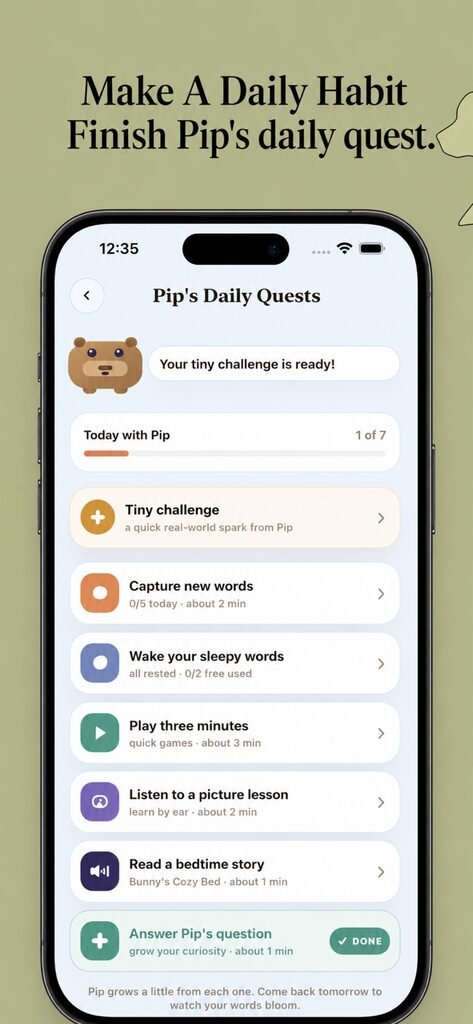
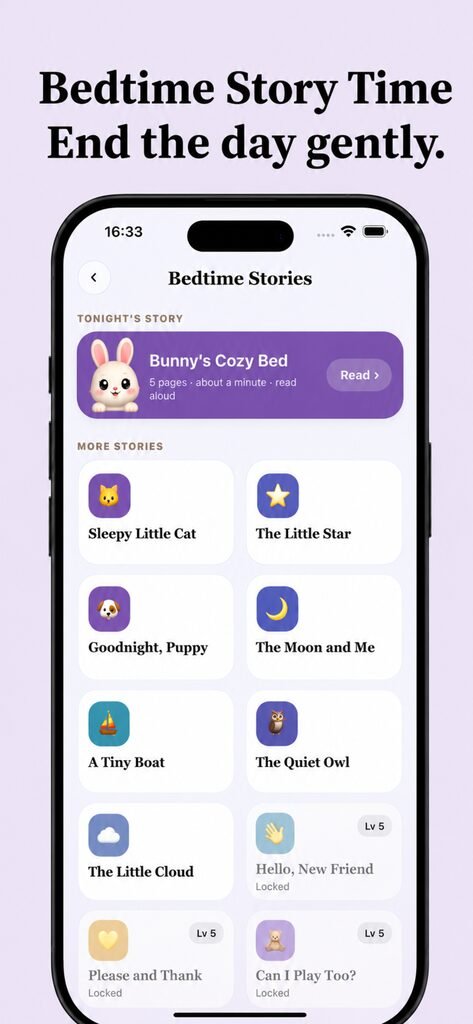
The three rules above are built in. Daily quests keep the session around three minutes and end it cleanly. Spaced repetition decides which captured words come back, and returns them inside eleven mini-games rather than as a test. And instead of your reminder, the child’s motivation comes from Pip: a companion who grows each time a boss is beaten at the gate of a new land. Every boss fight is quietly an exam made from the words that child personally caught: Nibbles the Gate Snail on day one, Nova the Star Dragon at the end of the road. The day finishes with a bedtime story built from the words they collected.
For the grown-up there is a word museum showing everything caught, so a week of hunting produces visible proof rather than a vague feeling. There are no ads, nothing is sold on, and shared cards contain only the cutout object, never the photo of your kitchen.
Conclusion
You do not need to speak fluent English, buy a course, or print anything to teach vocabulary at home. You need one room, five objects, three minutes and a habit of looking back at yesterday. Start with the kitchen tonight: the child will pick the strangest five things in it, and those are precisely the words they will still know next month.
More reading: what an AI word camera is and how it works · comparing photo vocabulary apps
❓ FAQ: teaching English vocabulary at home
Q: How do I teach English vocabulary at home if my own English is weak?
A: Use audio pronunciation and copy it together rather than teaching from memory. Learning alongside your child is more effective than instructing, and it removes the pressure to be correct.
Q: How many English words should we learn per day?
A: Five is a good target for a child, and consistency matters far more than volume. Five words a day with a review of yesterday’s beats twenty words in one sitting.
Q: What age can a child start?
A: As soon as they can name objects in their own language, usually around three or four for the hunting game, with more of the reading and writing coming later. Older children and teenagers can hunt more abstract things: tools, parts of machines, ingredients.
Q: How long until I see progress?
A: Expect recognition of the first 30 words within a week or two of daily three-minute sessions, and confident use of them after they have been met several times across different days. Progress shows up as the child naming things unprompted.
Q: Do I need to print flashcards?
A: No. The objects in your home are the flashcards, which is what makes this method free and impossible to lose.
Q: My child refuses “learning time”: what now?
A: Remove the word learning. Announce a hunt, give a challenge (“find something round”), let them hold the phone, and stop after three minutes while they still want more. Children resist lessons, not games.
Q: Is screen time a concern?
A: A three-minute hunt around the house is active and shared, not passive scrolling. PipWords is built with short sessions, natural stopping points, no ads and no endless feed for this reason.
Q: Can two children do it together?
A: Yes, and competition helps: let each child find five different objects, then test each other. Taking turns as the examiner is the most valuable part.
Q: Does this work for adults learning English?
A: The same method works well. Adults should hunt in the places their vocabulary is weakest (kitchen, workshop, office, hardware store) where textbooks are least useful.
🧑💻 About the Author
PipWords: the AI word camera
Written by the maker of PipWords, an independent app studio run by a parent-developer. This plan is the routine the app was designed around after watching a child abandon flashcard apps within a week: choose your own words, keep sessions short, and let a game handle tomorrow’s review. PipWords runs on iPhone and Android in 12 interface languages with translations in 17, with no ads and no data selling.
Questions, or a hunting ground we should add to the plan? support@pipwords.site