30 English Words and Phrases for Mealtime
The table, the meals and the polite phrases, with IPA pronunciation and sentences your family can use at dinner tonight.
PipWords: AI Word Camera

🍽️ Mealtime words in English
Mealtime English is three groups of words: the things on the table (plate, bowl, cup, fork, knife, spoon, napkin), the meals themselves (breakfast, lunch, dinner, snack, dessert), and about ten polite phrases: “Can you pass me the…”, “May I have some more?”, “It’s delicious”, “No, thank you”, “I’m full.”
Dinner is the single best English lesson in the day, because everyone is sitting still, nobody is being tested, and the same twenty words come up every evening. Learners who never open a textbook still learn this vocabulary quickly: it is simply the language of a repeated event. Part of the full daily routine vocabulary guide.
🍴 On the table (12 words)
| Word | IPA | Word | IPA |
|---|---|---|---|
| table | /ˈteɪbl/ | fork | /fɔːrk/ |
| chair | /tʃer/ | knife | /naɪf/ |
| plate | /pleɪt/ | spoon | /spuːn/ |
| bowl | /boʊl/ | napkin | /ˈnæpkɪn/ |
| cup | /kʌp/ | salt | /sɔːlt/ |
| glass | /ɡlæs/ | pepper | /ˈpepər/ |
🥣 Meals and food words (10 words)
| Word | IPA | When you use it |
|---|---|---|
| breakfast | /ˈbrekfəst/ | The morning meal. |
| lunch | /lʌntʃ/ | The middle-of-the-day meal. |
| dinner | /ˈdɪnər/ | The evening meal. |
| snack | /snæk/ | A small thing between meals. |
| dessert | /dɪˈzɜːrt/ | The sweet course at the end. |
| meal | /miːl/ | Any of the above. |
| water | /ˈwɔːtər/ | “Can I have some water?” |
| juice | /dʒuːs/ | “Orange juice, please.” |
| soup | /suːp/ | Eaten with a spoon, from a bowl. |
| salad | /ˈsæləd/ | Usually served cold. |
🗣️ The 10 phrases that matter most
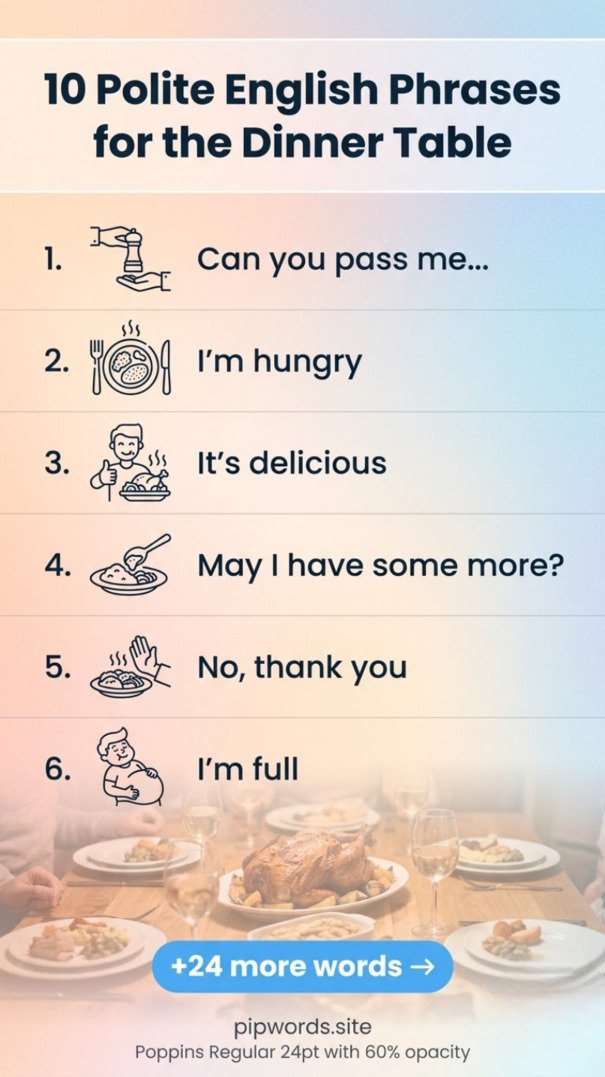
| Phrase | When to say it |
|---|---|
| Wash your hands. | Before sitting down. |
| Dinner is ready! | Calling the family to the table. |
| Can you pass me the salt, please? | Asking for something out of reach. |
| Help yourself. | Inviting someone to take food. |
| May I have some more? | Asking politely for a second helping. |
| It’s delicious. | Complimenting the cook. |
| No, thank you. | Refusing politely. |
| I’m hungry / I’m full. | Before and after eating. |
| Please don’t talk with your mouth full. | The universal parent sentence. |
| Clear the table, please. | When the meal is over. |
A note on politeness: in English, “Can you pass me the salt?” needs the word please to sound friendly. Without it, the sentence is grammatically perfect but sounds like an order, which is why children learning English are taught the phrase and the “please” together, as one unit.
Also useful: “I’m full” means you have eaten enough. Learners often say “I am satisfied” or translate directly from their own language, which sounds odd in English.
⚡ The “one English sentence per meal” rule
Do not turn dinner into a lesson: it will fail within three days and everyone will dread the meal. Instead use one rule: anything you want at the table, you must ask for in English. Nothing else changes; the rest of the conversation stays in your own language.
- Week 1: “Can you pass me the ___, please?”: the blank changes every meal, so one sentence teaches twenty nouns.
- Week 2: add “May I have some more?” and “No, thank you.”
- Week 3: add “I’m hungry”, “I’m full”, “It’s delicious.”
Because there is a real reward at the end, the salt actually arrives, the child has a genuine reason to produce the sentence. That is the difference between practice and homework.
📱 Catch tonight’s dinner
Before you eat, let your child photograph three things on the table with PipWords. Each becomes a word card in about 2 seconds (cut-out photo, English word, IPA, audio and a translation in one of 17 languages) and the app brings those words back later in the week inside a game. Free on iPhone and Android, no ads.
More in this series: morning routine · getting dressed · bedtime · 40 kitchen words
❓ FAQ: mealtime English
Q: What do you say at the dinner table in English?
A: The most useful phrases are “Dinner is ready”, “Wash your hands”, “Can you pass me the ___, please?”, “Help yourself”, “May I have some more?”, “It’s delicious”, “No, thank you” and “I’m full”.
Q: How do you say you have eaten enough in English?
A: Say “I’m full” or “No more, thank you”. Avoid translating directly from your own language: phrases like “I am satisfied” sound unnatural to English speakers.
Q: What is the difference between dessert and desert?
A: Dessert /dɪˈzɜːrt/ is the sweet course at the end of a meal; desert /ˈdezərt/ is a dry sandy place. The stress falls on different syllables.
Q: Is it “dinner” or “supper”?
A: Dinner is the standard word for the evening meal in most of the English-speaking world. Supper is used in some regions, usually for a lighter or later meal.
Q: How can I use mealtime to teach my child English?
A: Use one rule: anything you want at the table must be asked for in English. “Can you pass me the ___, please?” teaches twenty nouns through a single sentence, and the salt arriving is the reward.
🧑💻 About the Author
PipWords: the AI word camera
Written by the maker of PipWords, an independent studio run by a parent-developer. IPA is General American, with British variants noted where they differ. PipWords runs on iPhone and Android in 12 interface languages with translations in 17, with no ads and no data selling.