English Daily Routine Vocabulary: Morning to Bedtime
The 50 English words and phrases a child actually uses in one ordinary day — with IPA pronunciation, and the phrasal verbs that word lists always leave out.
PipWords: AI Word Camera
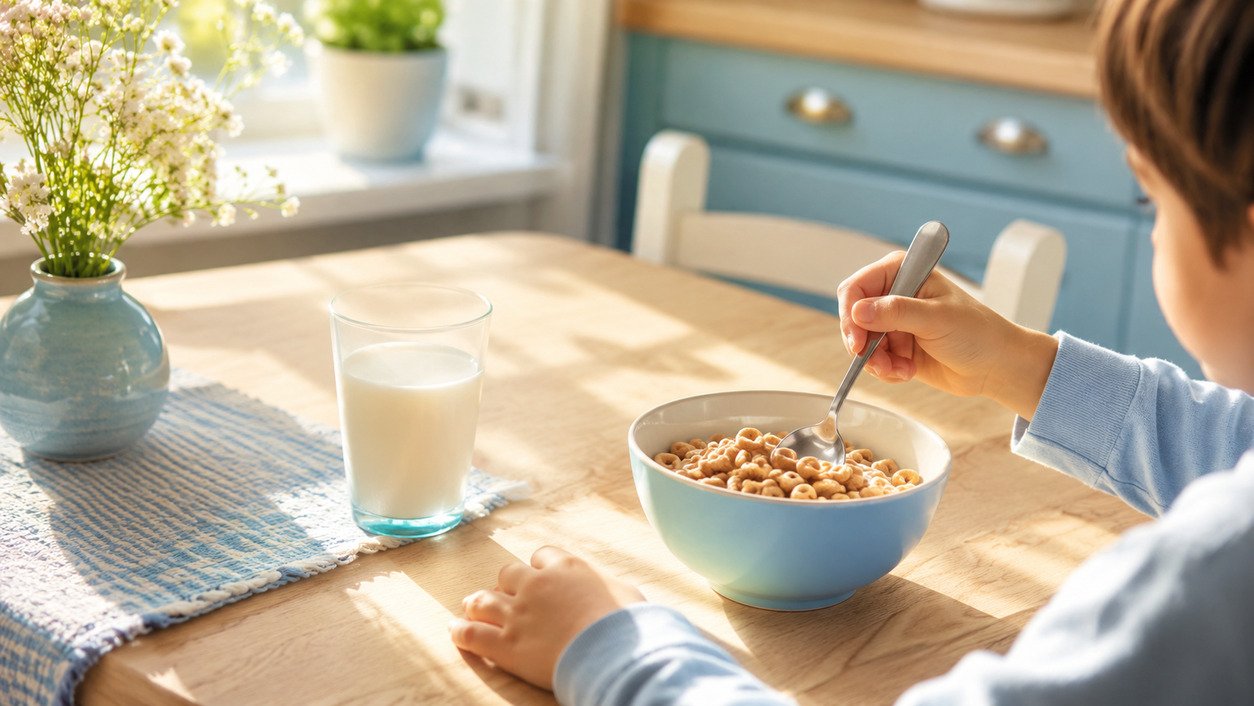
🌟 What is daily routine vocabulary?
Daily routine vocabulary is the set of English words and phrases used at fixed moments of the day: waking up, washing, getting dressed, eating meals, going to school and going to bed. Unlike a normal word list it is mostly verbs and phrases — wake up, brush your teeth, get dressed, put on, have breakfast, go to sleep — because a routine is made of actions, not objects.
This is the most efficient vocabulary a learner can own, for one reason: it repeats. A word met once a week needs five deliberate reviews to stick. A word that happens every single morning reviews itself. Teach “brush your teeth” once and the routine does the rest of the work for you — which is why routine language is where a beginner should start after their first hundred nouns.
Below is the whole day in order, with the four parts of the routine covered in depth in their own guides.
🕘 A whole day in English, in order
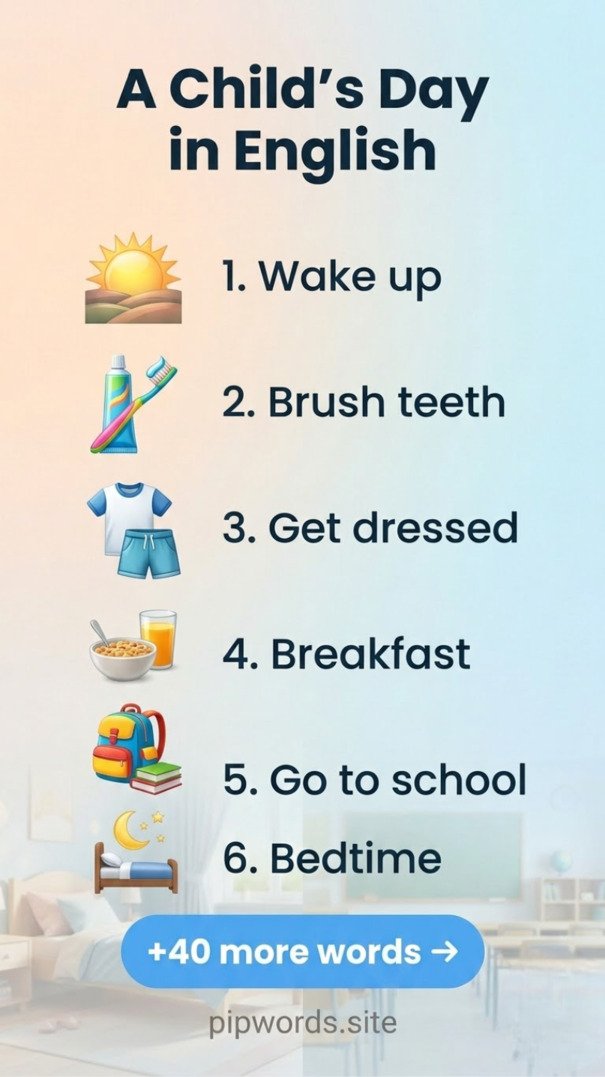
| Time | What you say in English | IPA of the key word |
|---|---|---|
| 7:00 | wake up — “Wake up, it’s morning!” | /weɪk ʌp/ |
| 7:05 | get up — “Get up, please.” | /ɡet ʌp/ |
| 7:10 | make the bed | /meɪk ðə bed/ |
| 7:15 | brush your teeth | /brʌʃ jɔːr tiːθ/ |
| 7:20 | wash your face | /wɑːʃ jɔːr feɪs/ |
| 7:30 | get dressed — “Put on your shirt.” | /ɡet drest/ |
| 7:45 | have breakfast | /hæv ˈbrekfəst/ |
| 8:15 | pack your bag · put on your shoes | /pæk jɔːr bæɡ/ |
| 8:30 | go to school | /ɡoʊ tə skuːl/ |
| 12:30 | have lunch | /hæv lʌntʃ/ |
| 16:00 | do your homework · play | /pleɪ/ |
| 18:30 | have dinner · set the table | /hæv ˈdɪnər/ |
| 19:30 | take a bath | /teɪk ə bæθ/ |
| 20:00 | put on your pyjamas | /pəˈdʒɑːməz/ |
| 20:15 | read a story | /riːd ə ˈstɔːri/ |
| 20:30 | turn off the light · go to sleep | /ɡoʊ tə sliːp/ |
🔑 The 10 phrasal verbs that run the whole day
This is the part most vocabulary lists skip, and it is the part that makes a learner sound natural. Ten phrases cover almost every routine sentence in English:
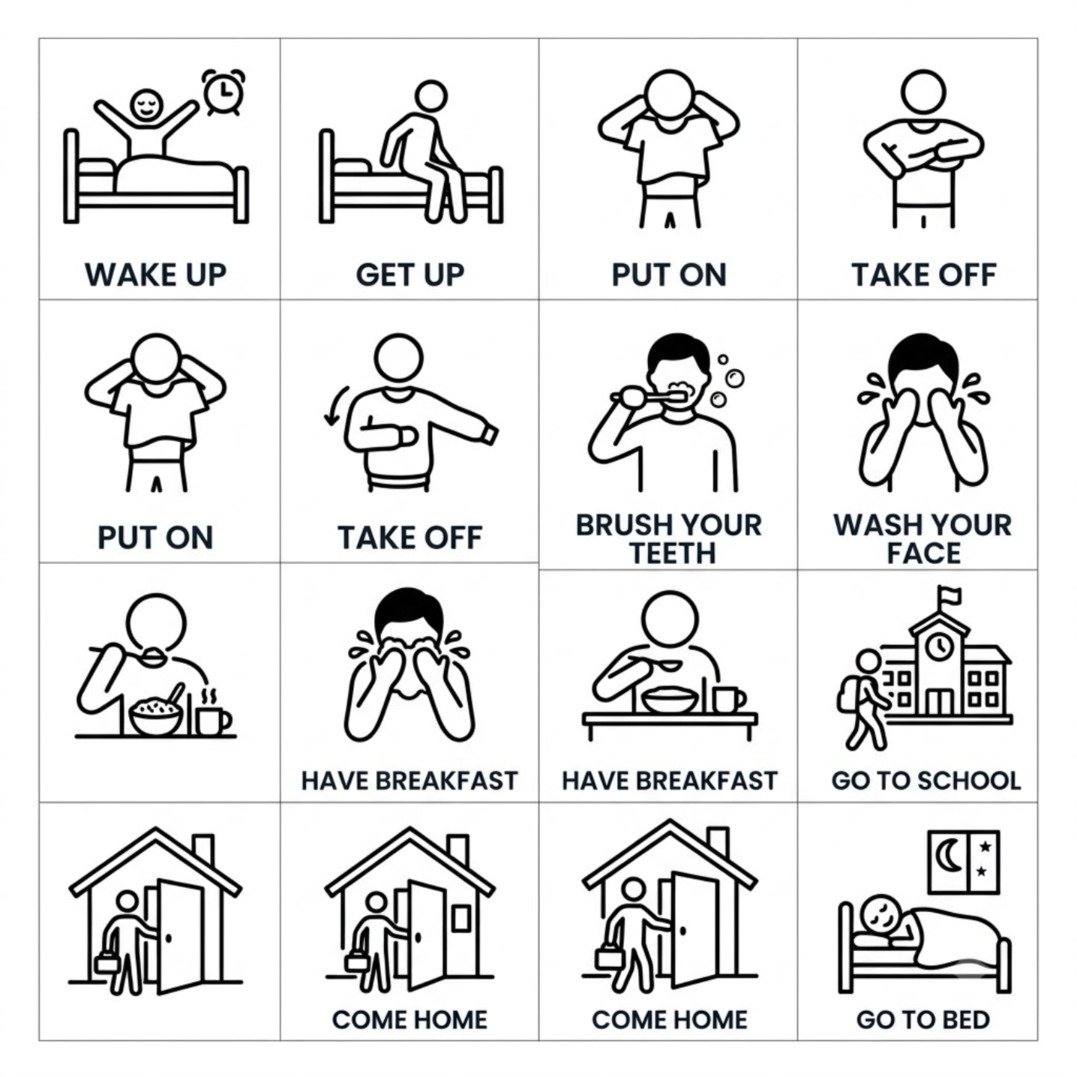
| Phrase | Meaning | Example |
|---|---|---|
| wake up | stop sleeping | I wake up at seven. |
| get up | leave the bed | Get up, we’re late! |
| get dressed | put your clothes on | Get dressed quickly. |
| put on | place clothing on your body | Put on your shoes. |
| take off | remove clothing | Take off your coat. |
| brush your teeth | clean your teeth | Brush your teeth after breakfast. |
| have breakfast | eat the morning meal | We have breakfast at eight. |
| tidy up | make a room neat | Tidy up your toys, please. |
| turn off | stop a light or machine | Turn off the light. |
| go to sleep | begin sleeping | Go to sleep now. |
The mistake almost every learner makes: saying “wear your shoes” instead of “put on your shoes”. Put on is the action of dressing; wear is the state of already having something on. “Put on your coat” (do it now) versus “She is wearing a red coat” (that is how she is).
📚 The four parts of the day in detail
- 30 English words for your morning routine — alarm clock to school bag, plus the washing verbs.
- 25 English words for getting dressed — every item of clothing, plus put on, take off and zip up.
- 30 English words for mealtime — the table, the food and the polite phrases.
- 30 English words for bedtime — bath, pyjamas, story and goodnight.
⚡ How to teach a routine (the “one moment” method)
Do not teach the whole day at once. Pick one moment and switch only that moment into English for a week.
- Week 1 — teeth. Every time your child brushes their teeth, the whole exchange happens in English: “Brush your teeth.” “Where is your toothbrush?” “Good job.” Three sentences, twice a day, fourteen repetitions a week.
- Week 2 — getting dressed. Keep week 1 in English and add “Put on your socks”, “Take off your pyjamas”.
- Week 3 — the table. “Sit down”, “Pass me the spoon”, “Are you hungry?”
- Week 4 — bedtime. “Time for bed”, “Read a story”, “Goodnight, sweet dreams.”
After a month, four moments of every day happen in English without anyone calling it a lesson — and no one has sat down to study. This works even if your own English is limited, because you are repeating the same short sentences rather than holding conversations.
📱 Catch the objects in your own routine
Every object in the table above is within arm’s reach right now. Point PipWords at your child’s actual toothbrush, their own school bag, the cup they drink from, and in about 2 seconds each becomes a word card with a cut-out photo, the English word, IPA, audio and a translation in one of 17 languages.
The app is built around the same idea as this guide: a short daily quest of about three minutes that fits inside an existing routine, with words returning on the day they are about to be forgotten. Free on iPhone and Android, no ads.
Related: 100 first English words · the 7-day word hunt plan · why kids forget words
❓ FAQ: daily routine vocabulary
Q: What is daily routine vocabulary in English?
A: The words and phrases used at fixed moments of the day — wake up, get up, brush your teeth, get dressed, have breakfast, go to school, have dinner, take a bath, go to sleep. It is mostly verbs and phrases rather than nouns.
Q: What is the difference between “wake up” and “get up”?
A: “Wake up” means to stop sleeping; “get up” means to leave the bed. You can wake up at seven and get up at half past seven.
Q: Do I say “put on” or “wear”?
A: “Put on” is the action of dressing — “Put on your shoes.” “Wear” is the state — “She is wearing red shoes.” Learners very often use “wear” where English needs “put on”.
Q: Is it “have breakfast” or “eat breakfast”?
A: Both are correct and both are common. “Have breakfast” is slightly more natural in everyday British and American English, and the same applies to have lunch and have dinner.
Q: How do I teach a daily routine in English to my child?
A: Switch one moment of the day into English for a whole week — teeth cleaning, for example — using the same three or four sentences each time. Add a new moment the following week. Repetition comes free because the routine already repeats.
Q: How long does it take to learn routine vocabulary?
A: About a month for the four main moments of the day, at one new moment per week. Because routine words repeat daily, they usually need far fewer deliberate reviews than ordinary vocabulary.
🧑💻 About the Author
PipWords — the AI word camera
Written by the maker of PipWords, an independent studio run by a parent-developer. The “one moment a week” method above is the routine the app was designed around: short sessions that attach to something already happening, rather than a lesson that has to be scheduled. IPA is General American, with British variants noted where they differ.
Questions: support@pipwords.site